
vip@litongglass.com
+86 16632961602

Refining the "transparent cornerstone"
Walking into the modern glass production workshop, what you see is not spark-flying forging, but a precision production line stretching for hundreds of meters. There is no noisy hammering sound here, only the low and harmonious running of the machine, like an industrial symphony.
The starting point of this production line is the precise ratio of a variety of natural minerals. The workers mixed silica sand, soda ash, limestone and other raw materials in a specific proportion and sent them to the high-temperature melting kiln. In the kiln at over 1,500 degrees Celsius, these solid raw materials gradually melt into hot liquid glass, like a golden river, ready to begin its shaping journey.
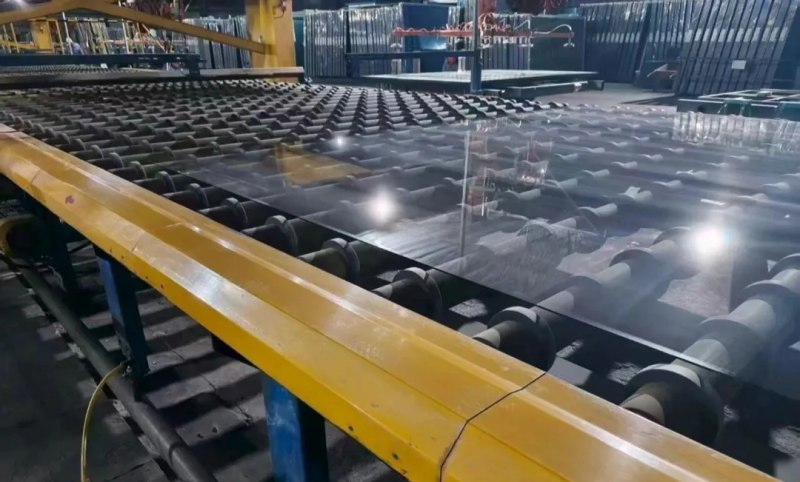
Molding is the core link of glass production. The molten glass liquid flows into the surface of the tin tank, and because the density of the glass liquid is less than that of the tin liquid, it will float on the surface of the tin liquid and naturally spread out to form a flat glass band on the upper and lower surfaces. This "float" process is the core technology of modern flat glass production.
The preliminarily formed glass strips then enter the annealing kiln. Here, the glass undergoes a strictly controlled slow cooling process to eliminate internal stresses and prevent cracking or deformation in future use. In the annealing kiln, the temperature is precisely controlled at around 600 degrees Celsius, and the glass band moves slowly, gradually cooling and solidifying through convection and thermal conduction.
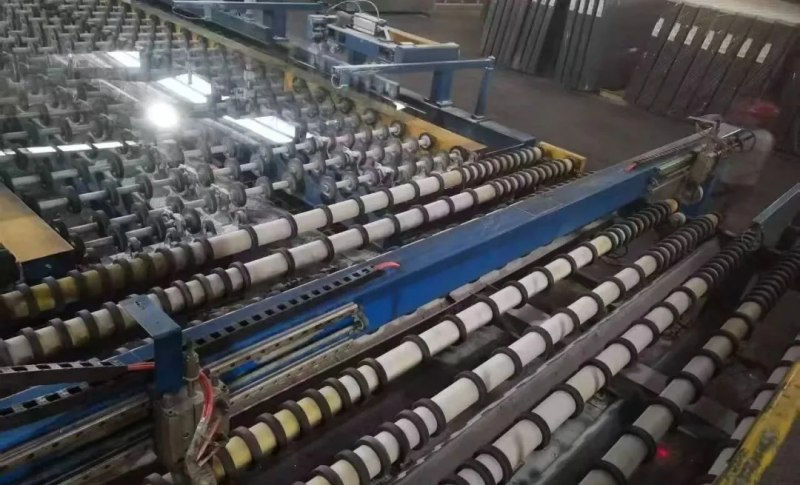
The cooled glass enters the finishing stage. The mechanical cutting machine precisely cuts according to the preset dimensions, turning continuous glass strips into standard glass plates. Each glass undergoes rigorous inspection to ensure that its optical properties and mechanical strength meet standards.
The safety details of the workshop also reflect the humanistic care of modern industry. The bright yellow protective railing is set along the production line, which not only delineates the safety boundaries, but also embodies the protection of operators in industrial design.
The red numbers on the production line brackets - "150", "151", "152", etc. indicate each node of digital management, and each process parameter is monitored and recorded in real time.
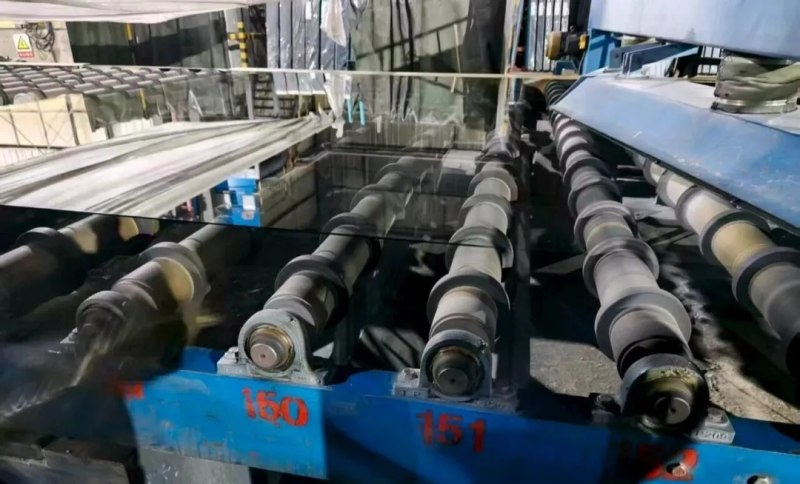
From raw materials to finished products, the float glass production process showcases the precision and beauty of modern industrial manufacturing. This seemingly simple transparent material is actually the crystallization of raw material science, thermal engineering, automation control and other technologies.
It will be used in construction, automobiles, furniture and other industries, becoming an indispensable "transparent cornerstone" in modern life.
Name: Litong Glass
Mobile:+86 16632961602
Tel:+86 16632961602
Email:vip@litongglass.com
Add:Shahe city,Hebei,China