
vip@litongglass.com
+86 16632961602

The architectural scheme of the project is designed by MAD Architects, and the main construction drawings and the whole process of the curtain wall are designed by Tongji University Architectural Design and Research Institute (Group) Co., Ltd., which is the crystallization of the wisdom of architects and curtain wall engineers, and will also become a model project to show the cutting-edge level of the industry in the curtain wall design competition.
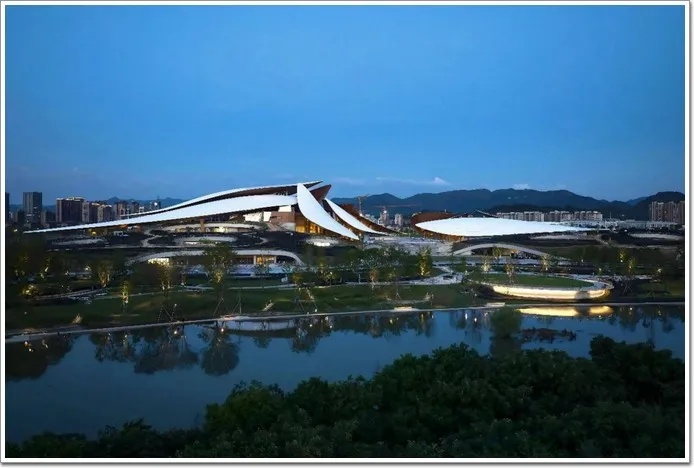
The project is located in Anji, Zhejiang, with a total construction area of about 120,000 square meters, covering core functions such as 1,300 grand theaters and a 2,000-person conference center, shouldering the mission of "transitional carrier" connecting the natural mountains on the west side and the urban space on the east side.
The curtain wall is based on the collaborative application of 8 types of glass curtain wall systems (FS-01 to FS-08), 3 types of non-light transparent curtain wall systems (aluminum honeycomb panels, UHPC, aluminum plate stretch mesh), and 3 types of decorative roofing systems of "blades", so that the building deeply echoes the regional characteristics from form to function.
Let "bamboo leaves" grow on the building
The design team transformed the natural imagery of Anji bamboo forest into a tangible architectural language, and the twelve "leaves" roof became the most distinctive visual symbol of the project.
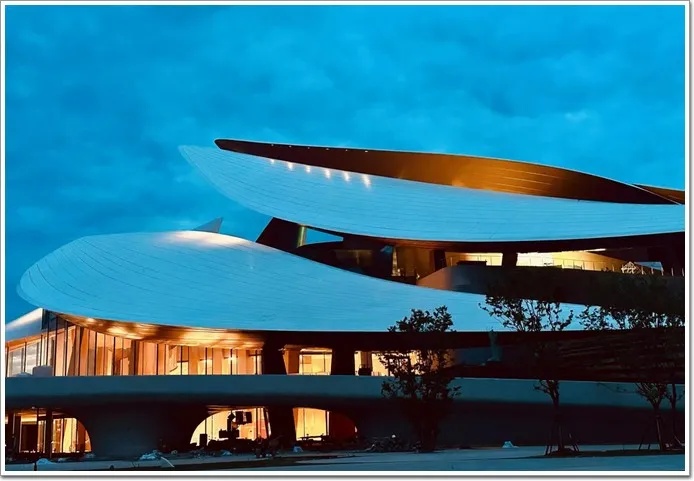
The roof system adopts the upper and lower two-color design of "white self-cleaning hyperbolic honeycomb aluminum plate + copper color hyperbolic honeycomb aluminum plate", the top surface restores the hazy texture of bamboo leaves, the bottom echoes the warm tone of the tea field soil, and the leaf edge is treated with a "wing"-like combination metal plate to weaken the thickness of the roof and achieve the flexible effect of slender edge of the leaf tip.
The façade innovatively applies the mutually supportive broken line all-glass curtain wall (FS-01) and the helpless self-supporting all-glass curtain wall (FS-03), the former simulates the interlaced broken line contour of bamboo leaves, and the latter strengthens the form of "single independent and symbiotic" form, with leaf vein decorative lines, to create a spatial artistic conception of "bamboo shadows intersecting".
The frameless ultra-high all-glass curtain wall (maximum height 19m) further obscures the boundary between architecture and nature, introducing the tea field and distant mountain landscape into the interior during the day, and the wood-colored space blends with natural light and shadow, making people feel like they are in a bamboo forest. At night, the warm-toned lighting forms a "bamboo leaf projection" through the broken line glass, projected on the ground and walls, echoing the poetry of "green waves like the sea", and achieving the design goal of "architecture is landscape".
Solve performance problems with technology
The project faces the challenges of ecological performance in complex forms, and through accurate analysis and innovative design, the curtain wall not only meets the aesthetic requirements, but also has excellent physical properties. It has reached high standards in terms of wind pressure resistance, water tightness and air tightness, effectively avoiding rainwater leakage and energy loss.
In order to solve the drainage problem of hyperbolic form, the design team used a CFD dynamic simulation system to analyze and simulate the drainage direction of complex roofs under different rainfall and wind speeds, and divided the twelve blades into three categories according to the water catchment characteristics according to the simulation results: L1, L2 and L3.
L1 type blades discharge more than 90% of rainwater through water pipe drainage; L2 is mainly based on water pipe drainage and supplemented by linear drainage, with a drainage volume of more than 70%; L3 ensures drainage efficiency through the cooperation of the two, comprehensively addressing the pain points of the industry where hyperbolic roofs are prone to water accumulation.
Provide hard-core support for symbiosis
The core breakthrough of the project lies in two major technological innovations, which provide a guarantee of "uncompromising form and uncompromising performance".
The first is the three-dimensional finite element analysis technology of the mutually supporting polyline all-glass curtain wall system (FS-01), and the team establishes a model through finite element software such as SAP2000 and Midas Gen to comprehensively analyze the stress, deflection, and structural adhesive stress of the glass. All indicators meet the safety standards to ensure the structural safety of the long-span polyline shape.
The second is the curtain wall articulated node (patent pleaded) that can absorb large interlayer displacement, in view of the complex deformation problem of the main structure, the node absorbs the Z-direction displacement through the top vertical waist hole, and the bottom rotation structure absorbs the X/Y direction displacement, and the anti-torsion structure is set up at L/4 and 3L/4, which can decompose the deformation in any direction, avoid the damage of the glass due to structural displacement, and ensure the stability and ecological performance of the curtain wall for long-term use.
Digital empowerment: Make design more accurate and efficient
Digital technology runs through the whole process of project design and has become a key tool for solving complex problems. In terms of surface optimization, the team uses Rhino+GH software to convert freeform surfaces into physical surfaces, and determines the optimal scheme by comparing the effects of hyperbolic, single-curved and flat honeycomb aluminum plates.
The curtain wall project of Anji "Two Mountains" Future Science and Technology City Culture and Art Center builds a complete value system of curtain wall design with regional humanities as the soul, ecological performance-oriented, and technological innovation as the wing. It not only breaks the industry dilemma of "form and performance cannot be combined", but also provides a replicable path for the curtain wall of regional cultural buildings "from image to landing".
In the curtain wall design competition, the project will become an important benchmark for promoting the development of the industry with its profound humanistic heritage, excellent ecological performance and cutting-edge technological innovation, injecting strong impetus into the new era of "humanities + ecology + technology" integration of curtain wall design.
Name: Litong Glass
Mobile:+86 16632961602
Tel:+86 16632961602
Email:vip@litongglass.com
Add:Shahe city,Hebei,China