
vip@litongglass.com
+86 16632961602

Why do safety glasses burst from time to time, and some even become the focus of society? In the eighties and nineties, ordinary glass cracks were radioactive or linear long cracks, because they were all ordinary glass at that time. According to the standard "DB13(J)T8434-2021" Article 3.0.3Many occasions must use safety glass. Therefore, safety glass is used in most occasions, and the most widely used safety glass is tempered glass, although laminated (glue) glass is also safety glass, but it is rarely used, according to the "General Code for Civil Buildings" only in special safety parts are used laminated (glue) glass. The tempered glass only self-detonated, so there is more safety glass, and the problem of self-detonation is naturally highlighted.
According to the national standard safety glass "GB 15763", it is divided into tempered glass and homogeneous tempered glass: (1).The tempered glass production process mainly includes the following processes: high-quality flat glass is selected, cut, edged, cleaned according to the needs, and then evenly heated to a point close to the softening point (about 600–700 °). C), so that the internal structure is relaxed and the original stress is eliminated. Then quenching (quenching), that is, after the glass comes out of the oven, the high-pressure cold air or liquid medium cools quickly and evenly, and the surface cools and hardens first, forming the stress distribution of surface layer compressive stress and inner layer tension stress, which is the key step of tempered glass.
(2) Homogeneous tempered glass On the basis of tempered glass, the tempered glass is hot-dipped (i.e., homogenized): at 290 °C± 10°C for several hours, so that the potential nickel sulfide impurities will burst in advance in phase change, and the hidden dangers will be eliminated before leaving the factory, and the general bursting rate of tempered glass will be removed3‰, which can be greatly reduced, can reach less than 1/10,000. However, homogeneous tempered glass is not compulsory by national standards, as far as the current market is concerned, the application rate of homogeneous tempered glass is very small, and the engineering is basically ordinary tempered glass.
The burst of tempered glass essentially has two types of "self-detonation" and "induced burst", the former is the root cause, and the latter is often catalytic and bursting mechanism It is a tempered glass surfaceThe imbalance of compressive stress-internal tension stress system can be divided into two categories: "congenital defects" and "acquired triggers", and the common scenarios are as follows:
1. Congenital defects
1. Phase transition of nickel sulfide (NiS) impurities, the cause of which accounts for the largest proportion and is not visible source of self-detonation, but is currently in productionThe process can only reduce the self-detonation rate to ≈3‰, which cannot be completely eliminated; When nickel sulfide stones remain in tempered glass, if they happen to be in the tensile stress zoneTempered glass can burst due to stress concentrations caused by the phase change expansion of nickel sulfide stones. This fundamental problem of the production process cannot be avoided or solved.
2. When tempered glass contains other hard stone particles (such as reduced elemental silicon, unmolten corundum, etc.)., and excessive tangential stress around it will also cause tempered glass to break. The impurities do not match the thermal expansion coefficient of the glass matrix, and there is residual tensile stress around the particles, but this is a glass product quality is unqualified, and it is only occasional.
The self-detonation caused by the above heterogeneous particles (such as nickel sulfide stone, elemental silicon, etc.) often has typical self-explosion cracks,The tipping point will have obvious butterfly spot characteristics, and obvious impurity points can be observed from the cross-section. According to statistics, there will be about one stone particle with a critical size sufficient to cause self-detonation for every 4t~12t original piece in the general float glass.
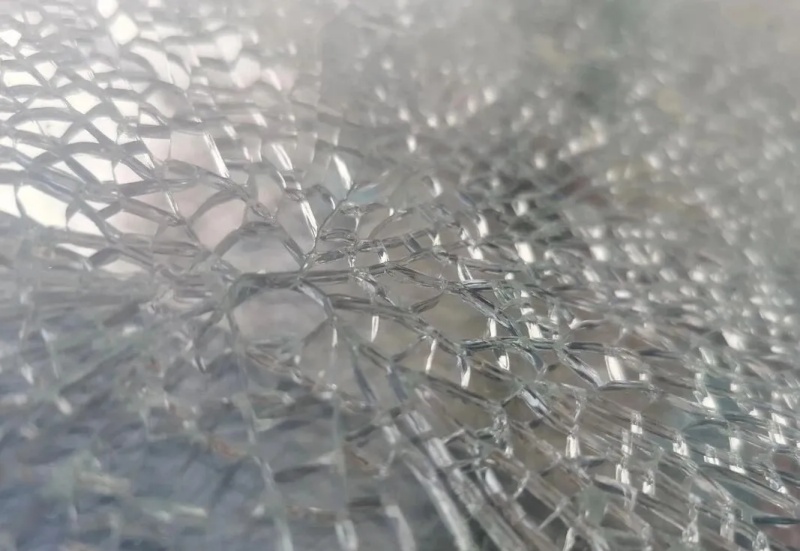
Therefore, the larger the size and thickness of the glass, the higher the possibility of self-destruction. This method of expressing the probability of self-detonation is called the self-detonation rate of tempered glass, expresses the weight of the tempered glass required for each unit of self-detonating heterogeneous particles, so the glass thickness is large and the natural weight is largeThe number of self-detonating heterogeneous particles will be higher. So the approximate method of calculating the self-detonation rate of tempered glassIt is divided by the total tonnage of a certain batch of tempered products by the number of self-detonation of this batch of tempered glass, and the number of self-detonationThe quantity can be obtained by macroscopic precise statistical methods.
3. Excessive tempering/uneven stress distributionExcessive tempering makes the surface compressive stress too high, and the internal tensile stress increases simultaneously. But for mature current production processes, this factor is even less.
2. Acquired inducements. The causes of self-detonation also include excessive glass tempering, uneven stress of tempered glass, and defective quality of glass edge processing
1. Thermal stress caused by sudden changes in temperature difference
The surface heats up quickly in direct sunlight and the temperature inside slowly; or sudden rainstorm/cold water after high temperature; or partially irradiated and partially shaded, resulting in uneven surface shrinkage and expansion, forming an inverse temperature gradient , the tensile stress superimposed on the original tensile stress exceeds the limit.
2. Edge/corner defects + mechanical or wind loads
Microcracks left by cutting and edging, edge chipping and cornering during transportation and installation, will destroy the edge compressive stress "protective layer"; Wind pressure, light impact of objects or extrusion of window frames can cause cracks to propagate in the tensile stress layer, resulting in "one touch is explosive".
3. Construction and installation problems, frame constraintsChange the glass stress, the gap between the glass and the notch is insufficient, the hardness of the spacer is improper, and the fastener is too tightor the thickness of the door and window profile is too thin, and the local deformation difference under the action of load is too large, these factors will convert the deformation into edge tensile stressLocalThe deformation is blocked, the stress is concentrated, and the defect is causedRupture.
4. The area of glass plate is getting bigger and bigger, and the glass is thick Correspondingly, there is no thickening, i.e. the "relative thickness" of the glass decreases". Under the condition of the same temperature difference, the deflection and edge constraint stress are exponentially amplifiedThe "relative thickness" is decreasing, which will also reduce the flexural strength to a certain extent, and significantly increase the probability of glass bursting. When the tempered glass plate surface is large, the frame or fixture causes the extrusion of the glass edge; When the self-weight of the glass is too large, the local stress generated by the glass and the supporting spacer is concentrated. When the glass is used in a strong alternating temperature field, it causes temporary thermal stress superposition effectcan cause glass to shatter or explode in a non-impact state。
According to the "Technical Regulations for the Application of Architectural Glass" JGJ 113-2015, Table 7.1.1-1The article stipulates that the maximum allowable area of safety glass has a corresponding thickness limit, but some engineering projects in the actual project do not meet the structural requirements of the minimum thickness of the glass, resulting in too much deformation of the glass during the later use, resulting in the stress at the stress spot exceeding the trigger defect thresholdOriginally, the burst point had not yet reached the stress limit of the response, but under this trigger, it may induce glass burst, which greatly increases the probability of glass bursting.
3) Relevant conclusions and suggestions:
1. Completely eliminate impurities such as nickel sulfide, which is unrealistic in terms of the current objective production process. The self-detonation rate exists objectively and is difficult to fundamentally eliminate, but a certain proportion should be controlled to reduce economic losses and reduce social impact.
2. When conditions permit, the use of "homogeneous tempered glass" instead of "ordinary tempered glass" can be promoted, which can greatly reduce the self-explosion rate of glass and have certain social benefits, but manufacturers have certain soft resistance in the market due to the low cost performance in terms of economy.
3. Developers, construction enterprises and manufacturers should be highly responsible to the owners, improve service awareness, deal with them in a timely manner, actively resolve conflicts, and reduce the complaint rate and social impact.
4. With the implementation of the new national standard for safety glass, the national standard for safety glass for construction GB/T 15763.1-2025 will be2026.8.1 implementation, new requirements such as stress spot and bending strength are put forward, and if the requirements for homogeneous tempered glass can be further included in the process of compiling good house standards, it will further reduce public complaints about glass.
Name: Litong Glass
Mobile:+86 16632961602
Tel:+86 16632961602
Email:vip@litongglass.com
Add:Shahe city,Hebei,China